Posts

Showing posts with the label Trans-Europa Express
Image
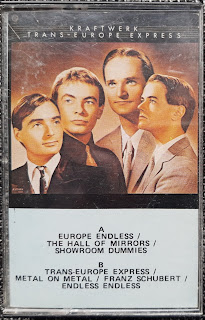
TRANS EUROPA EXPRESS (Germany, 1977) EMI ELECTROLA 1C 264-82 306 German cassette today, it's Trans Europa Express! You may recall the mid-80s reissue posted here earlier, this is - I think it's the first; at least a 70s edition.  The 1977 edition had a 2-panel J-card, to make room for a panel of other releases on EMI. I suppose Kraftwerk were a little difficult to market at the time, before electronic music was a thing? So here, EMI Records hope that if you like this album, then you're probably into schlager... Of the six releases, five are compilations of hits (well, one live album), and titles like "Abendland", "Super Oldies", "Alle Meine Jahreseiten" exclude us from the "Hits for Kids" section. Rock'n'roll this is not! Maybe the marketing genius in charge took a look at the front cover, and decided that four white men in suits would probably make music for the elderly... The front has the EMI Electrola logo on the top and...
Image
TRANS-EUROPA EXPRESS (Poland, 1991?) Unofficial Mateos  91159 So, another Polish pirate cassette today, but it's not The Mix this time! Poland, as indicated on this blog before, is the one country that has produced the highest number of different Kraftwerk cassettes. Polish copyright law, or possibly lack of law enforcement, made it easy to make a limited run of cassettes without contacting the legal owners, and there are dozens of different labels that have put out one or more Kraftwerk cassettes. Sometimes, it's just a version of one of the albums, other times it's something more elaborate, including "greatest hits" type compilations. Most releases will have some special design feature setting them apart from their competitors.  Another feature I have began to regard as typically Polish, is that they will often have tampered with the tracklist in one way ot another, mostly to bring the playing time down to standard length. Rather than present the buyer with one ...
Image
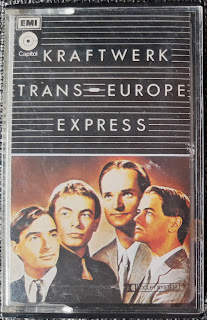
TRANS-EUROPA EXPRESS (Australia, 1980s) Capitol TC-MID-166109 Back to Australia again! From a Kraftwerk cassette collector's perspective they put out quite a lot of interesting releases - certainly more than I knew when I started collecting! Most cassettes from Australia - whether first-issue or re-release - come with nicely un-imaginative design; sometimes based on the UK cassette counterparts, sometimes just the LP front against a white background. This one, which I think is from 1987, falls into the latter category, and looks like you'd expect it to if you've seen the LP version with colour front (as released in Australia, and also UK, US, Japan, Sweden and others, I talked at some length about it in an earlier post ). There's no mistaking it for the first edition though, as the LP design is moved towards the middle of the front, with the band name above. It looks like this cassette is the counterpart to a 1987 mid-price reissue on LP, with the same catalogue nu...
Image
TRANS-EUROPE EXPRESS (Canada, 198?) Capitol 4N-16301 Sometimes, writing about these cassettes makes me revisit previous posts. This time, here's the Canadian re-edition of Trans-Europe Express, which made me check a few others... Most Canadian cassettes come in a simple 1-panel J-card, printed on one side only, and this one is no exception. The backflap has the legal info, and a note that says "Previously released as 4XW-11603", setting it apart from the first edition. The cassette is black with grey print.   As an aside, the reason I checked previous posts was that I noticed the Dolby logo has "HX PRO" printed on it, and I have forgotten when that was introduced. One source on the www claims that Dolby HX Pro - sometimes only known as Dolby HX, an acronym for Headroom eXtension - was introduced in the early 1980s, so if that is correct, this cassette is not from the '70s. It shares label design with the mid-80s re-issue of Radio-Activity , too, so it sta...
Image
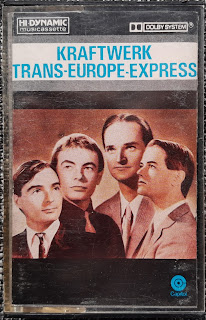
TRANS-EUROPE EXPRESS (India, 1977) Capitol 4TCS SW 11603 I haven't had an Indian cassette in an age, but here's an Indian edition of Trans-Europe Express. No idea why it hasn't been featured, it's by no means a recent acquisition, but that's how it is! It's a fairly lovely release, though, with some slight changes to the graphics on the front compared to any other issue; just a white box with the title and band name in bright blue letters across the top of the sleeve, and the "sheet music" stripes are gone, but it looks a little different to all other versions. The J-card is two-panels, printed on one side. The Indian cassette disregards the problem of different lengths to each side of the cassette, so you get the songs in their correct order here. Labels are white, on grey cassettes with "Made in India" stamped into the lower part of one side.  Intriguingly, the front cover has a logo presenting this as a "Hi-dynamic musicassette"!...
Image
TRANS-EUROPE EXPRESS (UK, 1977) Capitol TC-E-ST 11603 - 0C-262 82 353 An interim-post this time, a short message to present another UK edition of Trans-Europe Express. Nice to have some of these variants I keep mentioning! I had a nearly identical edition on the blog back in October 2023 - the difference is simply that the tracklist is printed on the actual shell of this one, whereas the other just has "See inlay for details" on both sides. The J-cards are the same; full-sized two-panel J-card, on glossy card stock, printed on both sides. Again, the tracks are jumbled around; Showroom Dummies and Franz Schubert are switched, in order to make the programmes more equal of length. Later cassettes had the correct track order.
Image
TRANS-EUROPE EXPRESS (Australia, 1977) Capitol TC-ST-11603 Back to Australia for this one, there still quite a few releases from that great country that I havne't presented here! The standard design of first-issue cassettes from Australia is pretty straight forward - either based on the UK cassette counterparts (like Autobahn), or a very simple version with the LP sleeve against a white background. The front of this, which I suppose to be the first Australian cassette edition, has the band name and title in larger letters underneath the picture. (I have seen later issues, a mid-80s reissue with the cat.no TC-MID-116109 - MID surely must refer to the price range? - and one with the cat. no beginning in TC-SW, with a pink background on the front.)   The J-card is 2-panel, and although it does have print on both sides, with the inside giving a list of "do's and dont's" on how to care for your cassette. It seems kinda cute these days, but otoh, if you followed thes...
Image
TRANS-EUROPE EXPRESS (The Netherlands, 1977) Capitol 5C 264.82306 I don't expect many bands would actually sing their songs in different languages? Well, of course, there was Eurovision, where artists might enter a song in their own language, then sing it in English if they won the competition... Anyway, today I'm presenting a rare edition of Trans-Europa Express from the Netherlands, and again I'm fascinated by the language confusion of Kraftwerk releases from this country! I've posted two different editions of Computer World from the Netherlands before, one a mis-print where the titles are printed in English, but the songs are actually song in German, while the other is the English version on tape as in print. A lot of LPs were manufactured that play German but have English titles, and now, here's a TEE cassette that bears the German titles, but has the music in English - except for one printer's error in "Europe Endlos". The cover is a one-panel J-...
Image
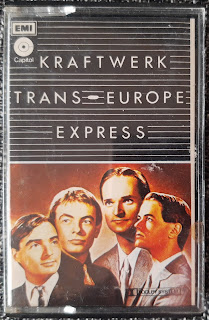
TRANS-EUROPE EXPRESS (UK, 1977) Capitol TC-E-ST 11603 - 0C-262 82353 We will now have a short break in this barrage of Polish pirate tapes in order to present this, the UK edition of Trans-Europe Express. Not exactly what you'd call a monster rarity, but a nice item, pretty to look at, and very official, so here we go! The cover is a full-sized two-panel J-card, on glossy card stock, printed on both sides - but the inside is just a bit of legal notices and such. As pointed out before on this blog, the UK, US, and a few other territories used the J. Stara colour collage for the front cover, whereas many european territories including Germany, Italy and Spain would use the Maurice Seymour photograph. The UK got the colour a bit wrong, it's over-saturated and looks orange tinted, but they liked the design enough to keep it for their later Fame label reissue .  The cassette came in many variants, both originally and the Fame reprints; most shells are grey, although an early 80s ve...
Image
TRANS-EUROPE EXPRESS (Greece, 1977) Capitol 2J-262 82306 Here is an interesting item I've been looking forward to posting here: The Greek edition of Trans-Europe Express. Quite rare, in fact I wasn't sure of its existence until a few months back, when it was listed on Discogs. The cover is a full-sized two-panel J-card, on glossy card stock, print on one side only. Let us marvel at the print in question for a second: The b/w version of the cover (ie. the one used in most European countries, but not in the UK, Americas N and S, Japan... or Sweden) is slapped in the lower part of the front panel, actually at a slight angle, and above it, the band name and album title in the most garish "70s" letraset typeface imaginable. I mean, it looks more out of place even than the "wild west" letters from the spine of the original German Ralf & Florian cassette. On the other hand, it looks different, and together with the rarity of the item, I suppose it's sort o...
Image
TRANS-EUROPE EXPRESS (Italy, 1977) Capitol 3C 264 85110 Italy is an interesting country as Kraftwerk cassettes go, with many releases and variants. Today's post is a kind of follow-up on an earlier post ; two cassettes that look quite similar, but have different catalogue numbers! So, as mentioned in that previous post, this album has been released across many territories with different cat.no's - Sometimes, variants ending with 82306, or 85110. 3C is the country code for Italy (France is 2C, Spain 10C, Brazil 31C etc), and at least the 2 in 264 indicates the cassette format (the corresponding LP has 3C 064 85110, so with just the one cipher to distinguish, it stands to reason that's what the cipher means). Apart from the catalogue numbers, there is not a lot of difference between this and the previous post. They each come with a 2-panel J-card, printed on one side only. Both cassettes have a blue shell. The cover design is the same, based on the black and white LP sleeve ...